Tag Archives: Internships

Intro to Science Diving and the Salish Sea

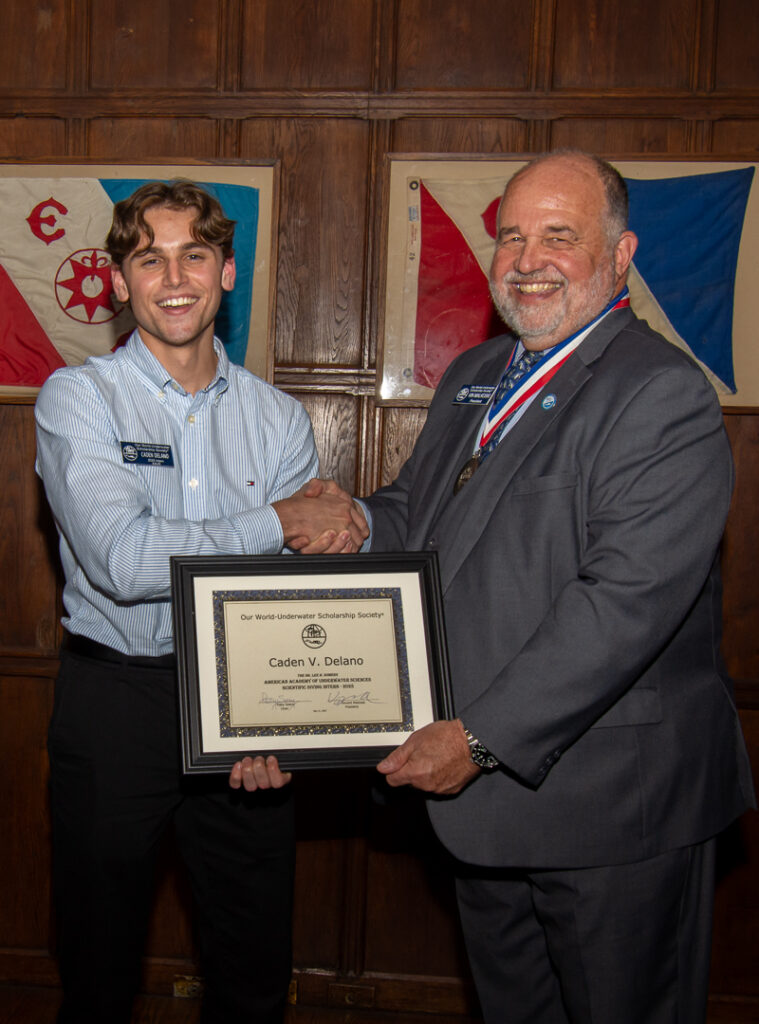
University of Florida student and Florida Museum of Natural History employee Caden Delano being congratulated by Vin Malkoski for the Our World Underwater Scholarship Society American Academy of Underwater Sciences Somer's Internship.
Officially Receiving the Dr. Lee H. Somers Internship from OWUSS President Vin Malkoski
Photo Credit: Our World-Underwater Scholarship Society

Hi there, my name is Caden Delano and I am a marine science student from the University of Florida and an ichthyologist at the Florida Museum of Natural History. I would like to start off by thanking the Our World Underwater Scholarship Society (OWUSS) for giving me the honor of receiving the Dr. Lee H. Somers Scientific Diving Internship. My expectations and excitement for the summer internship consumed me for weeks as I prepared my travel plans to Washington. I was certain that my experience diving in Florida would serve me well, but I knew that the cold water, strong currents, low visibility, and task loading that I would be introduced to would serve to mold me into a skilled diver. I was grateful to have this opportunity and excited to begin!
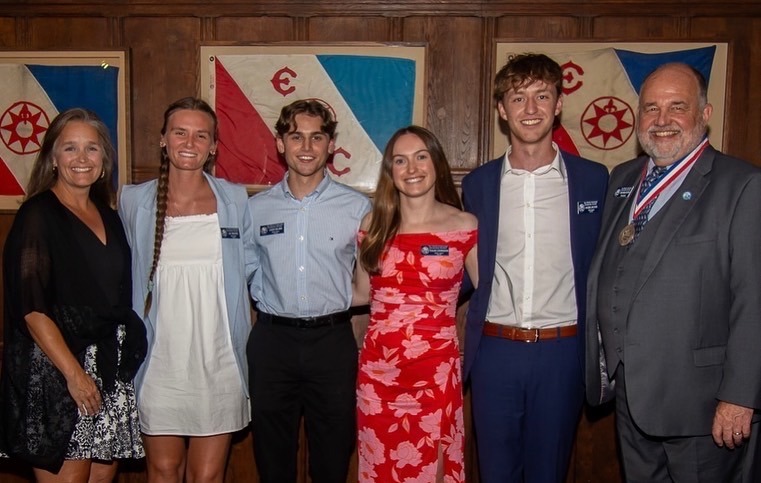
Our World Underwater Scholarship Society American Academy of Underwater Sciences Interns standing with Caden Delano, Heather Albright, and Vin Malkoski.
OWUSS AAUS Interns standing with Heather Albright and Vin Malkoski.
Photo Credit: Our World-Underwater Scholarship Society

I connected with many inspired OWUSS members during the 51st Annual Awards Ceremony in New York City and watched the quality presentations of my peers. That same enthusiasm was found at the Shannon Point Marine Center, where I obtained my scientific diving certification, aided in abalone conservation research, and conducted young of the year (YOY) rockfish surveys under many inspired scientists. In addition to thanking the OWUSS, I would like to extend my gratitude to the American Academy of Underwater Sciences (AAUS), Shannon Point Marine Center (SPMC), and Fourth Element for supporting me throughout my summer internship. Every one of these organizations welcomed me with open arms and made my summer memorable.


I arrived in Anacortes, WA and immediately met one of my mentors, Dr. Derek Smith! Derek was eager to ensure I had everything I needed to succeed upon arriving. He also entertained me with stories from his time studying marine science around the globe. I can confidently say that I have now gained a few of my own stories from my experience this summer.
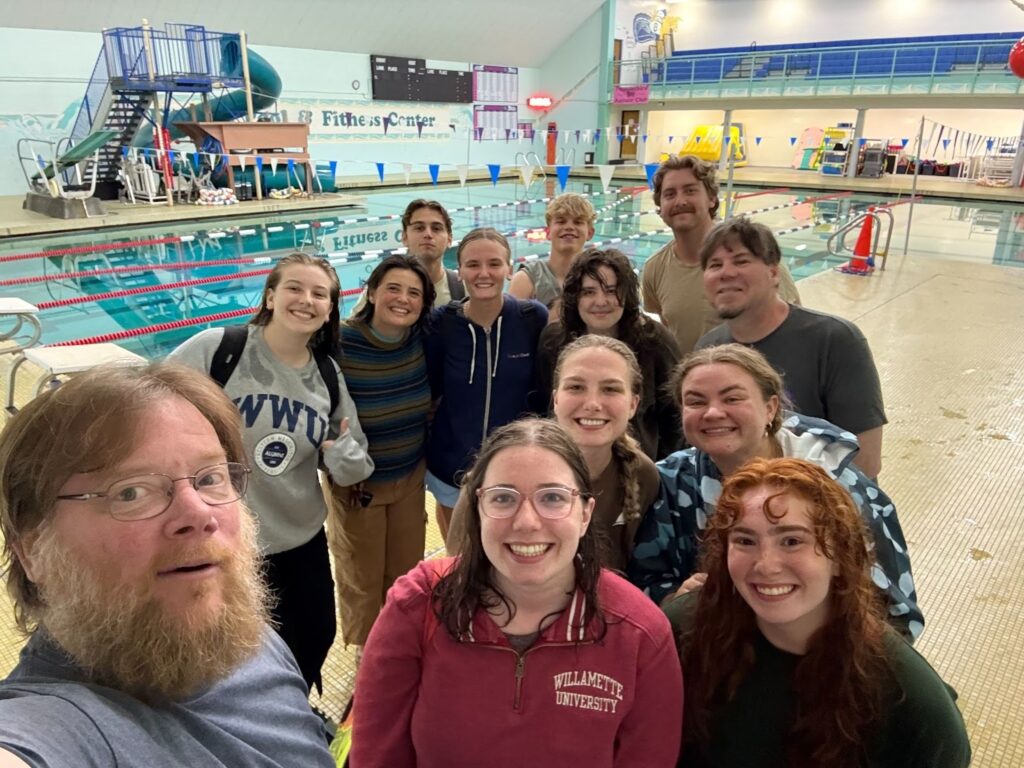
SPMC scientific diving team. Photo Credit: Dr. Derek Smith

One of my peers, Lily Moore, and I received our brand new wetsuits, booties, and gloves in the mail, courtesy of Fourth Element. Upon testing them in the water we found that they fit nice and snug while keeping us warm in the 50℉/10℃ waters of the Salish Sea! The rest of the gear we needed to conduct research this summer was graciously provided by Dr. Nathan Schwarck and the SPMC dive locker. We started our scientific diving training in the Fidalgo Pool & Fitness Center and created a team of dependable divers along the way.
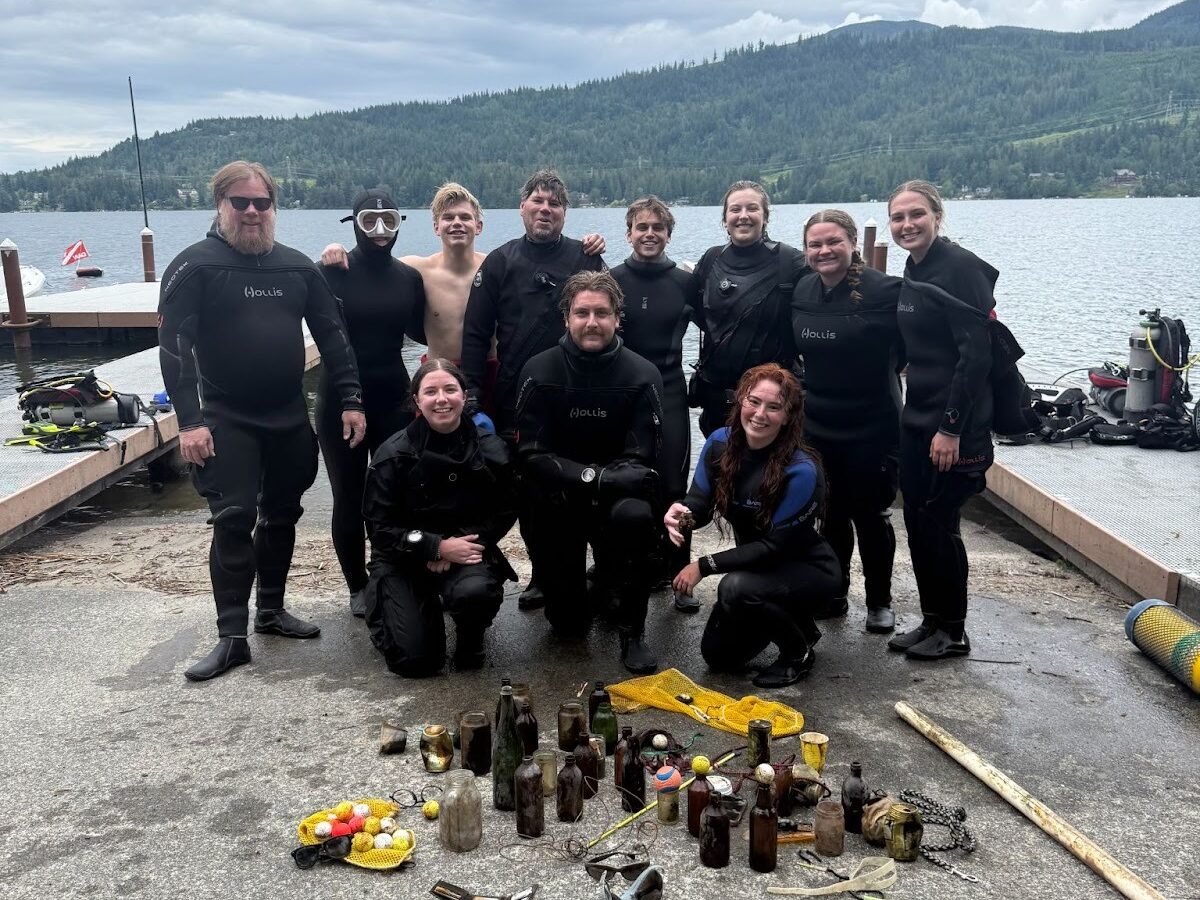
Shannon Point Marine Center, Western Washington University scientific divers cleaning up Lake Whatcom.
The 2025 SPMC Scientific Diving Class 2025 presenting their cleanup dive haul. Photo Credit: Western Washington University Lake Whatcom Staff

After our pool training we kicked off our summer scientific diving program by doing a cleanup dive at Lake Whatcom. Navigation was difficult in the murky water with little to no natural landmarks to guide us. Nate didn’t have a problem navigating right to us, a skill we continued to work on throughout the summer. By the end of our dive we were flush with golf balls, but the most notable was a Western Washington’s Student wallet and ID found by Derek.

Our dive training continued as we learned how to handle heavy objects underwater with lift bags. This training was particularly helpful because the scientific diving team was later tasked with retrieving three artificial reef modules after they had been submerged for a one year period. They were held down by heavy cement bricks, and were completely covered in algae that blended into the rest of the sea floor. To make things worse, we could only dive on the slack tide, otherwise the current would take us faster than we could kick. We had to use our navigation skills, teamwork, and lift technique to successfully retrieve them in our 10 minute window, but the good news is we had two slack tides in the day. Our first attempt was demoralizing. We retrieved one of the reef modules, but the current fought us soon after. We needed to take half the amount of time to grab the next two modules, so we formulated a plan. The OWUSS Mitchell Scientific Diving Intern Lilly Moore was especially helpful and took charge of the operation. A well defined plan was exactly what we needed in order to work in quick succession and get the other two reef modules out of the water.

While we had gotten experience lifting heavy objects out of the water, in the dive rescue certification course we took turns lifting our “unconscious” buddies out of the water! We also practiced CPR and the use of AEDs in the event of a dive emergency. The instruction provided by Dr. Smith and Capt. Schwarck was invaluable and exceeded the standards of a classic rescue diver scenario. The challenging conditions of the Salish Sea such as the frigid waters and rocky shores created the perfect training grounds. I came out of that course knowing I’ve prepared for the worst so I can meet future challenges at my best.
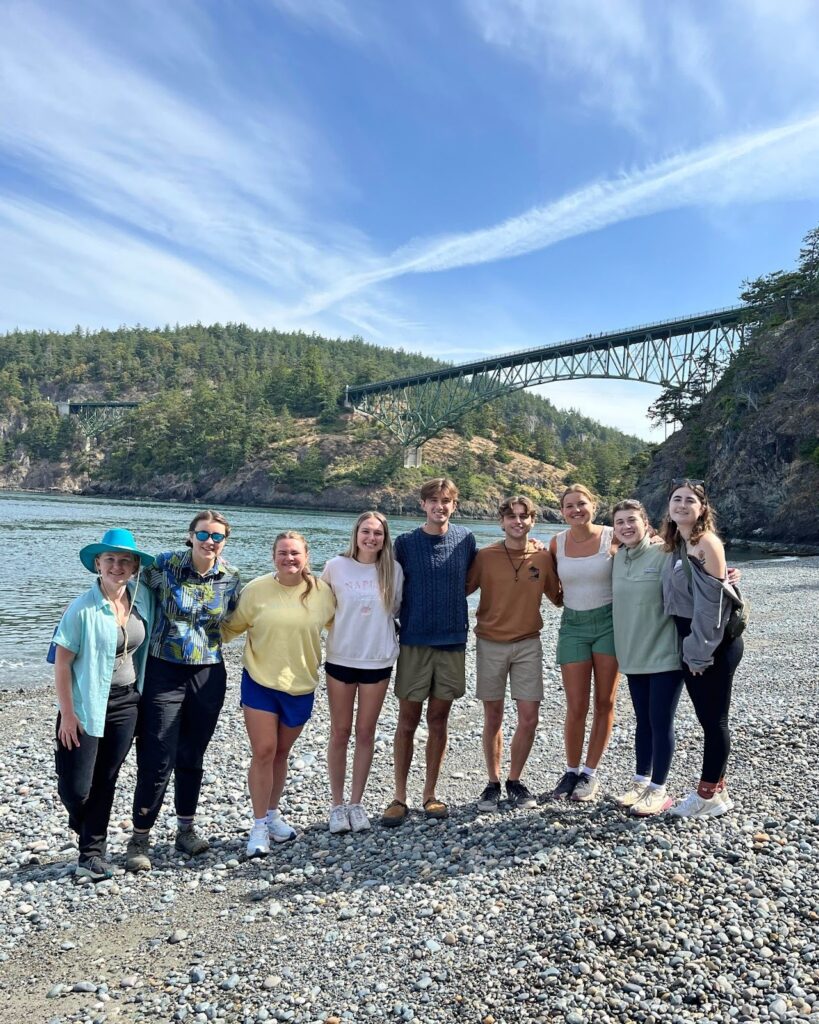
Deception Pass State Park, WA. Photo Credit: Dr. Brian Bingham

Dr. Brian Bingham led the Research students and OWUSS/AAUS interns on a hike around Deception Pass, a breathtaking landmark with astonishing currents and an interesting history of deceiving Captain George Vancouver into thinking it was a bay or inlet.
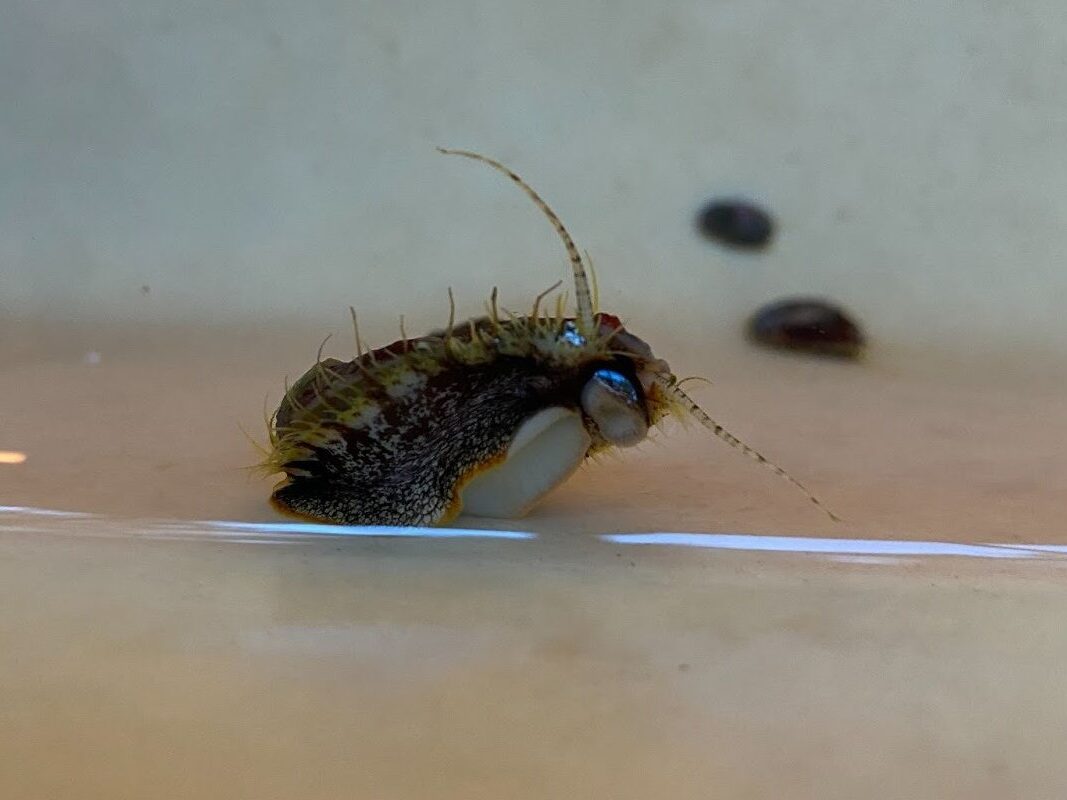
Photo of juvenile pinto abalone taken by University of Florida student Caden Delano at the Western Washington University's Shannon Point Marine Center.
Juvenile Pinto Abalone


A few weeks later marked the beginning of our research focus. Our shipment of 2,867 juvenile abalone arrived, and with it, a responsibility to keep them alive. The first week after they arrived we noticed the abalone made a habit of climbing out of their sea tables and desiccating, so our young team of scientists rotated checking on the abalone and placing them back in the water until they grew accustomed to their new environment. They were fed with dulse seaweed and their tanks were cleaned as necessary. This experience was a great introduction to husbandry, a skill I expect to use more often in the field of conservation research.
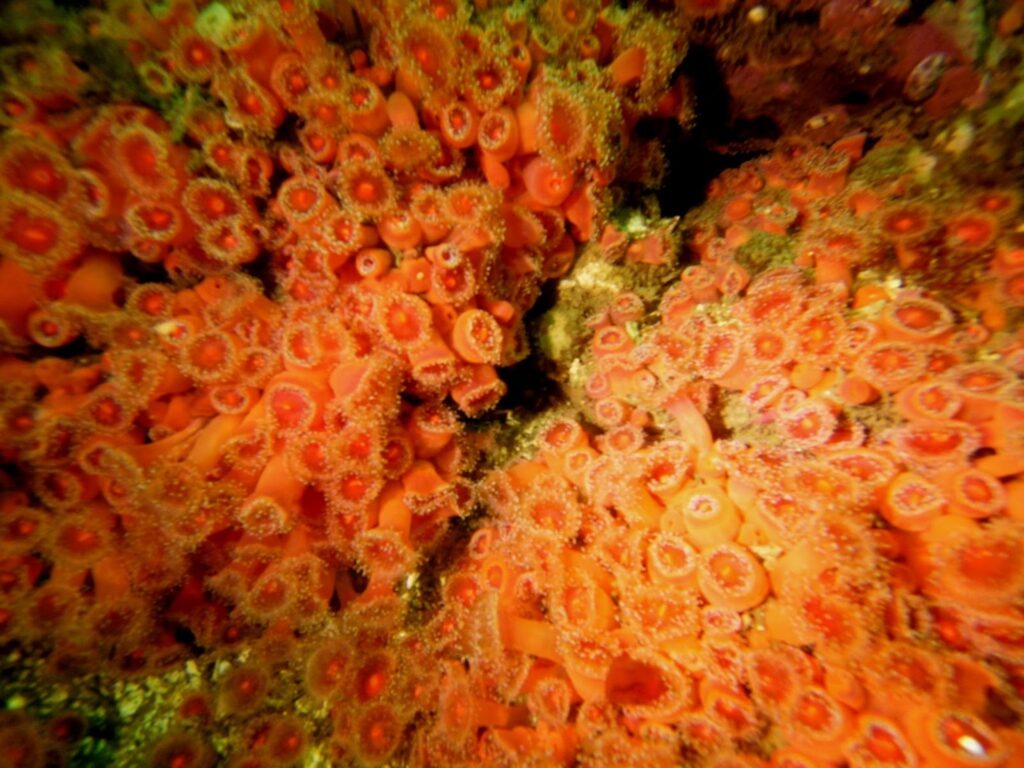
Strawberry Anemone
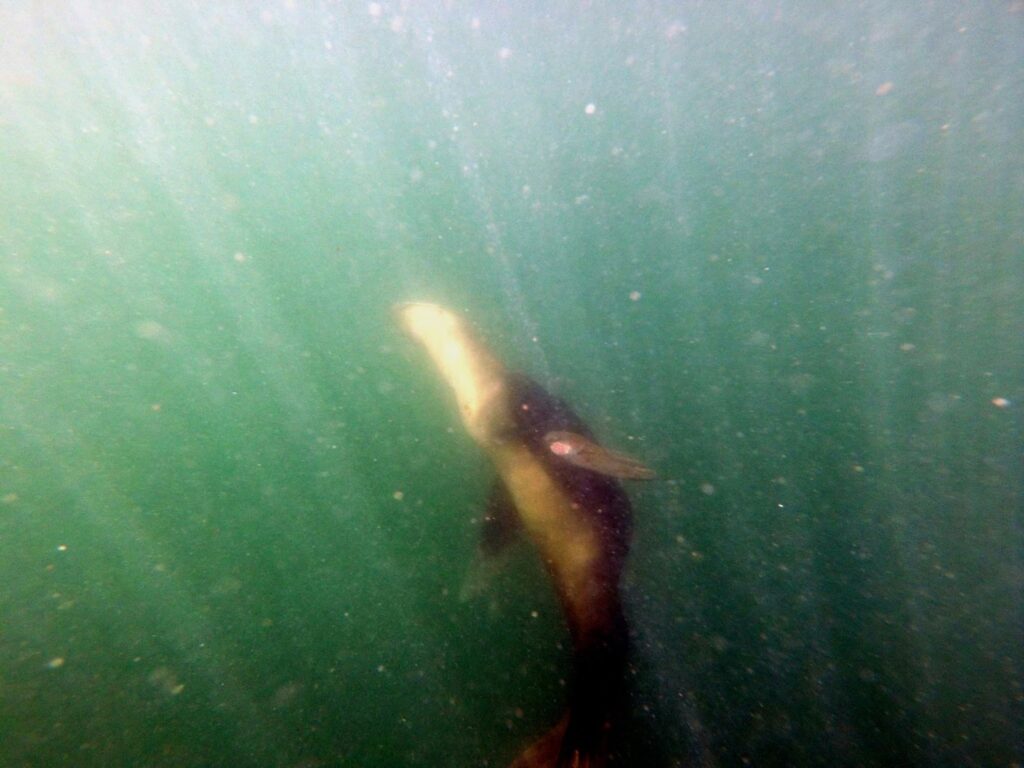
Stellar Sea Lion

One of my favorite dives this summer was when the 2025 SPMC Science Diving Class visited the legendary Strawberry Falls dive site, famous for its thriving strawberry anemone population and high biodiversity due to its proximity to the open ocean. On our ascent, I heard a muffled scream through my dive buddy’s regulator at the same time that a torpedo shot past us. I captured a blurry picture of what turned out to be a curious Steller sea lion as it swam by. Seeing a sea lion underwater checked a box off my bucket list!

Share

One Month in the Maldives: A Coral Wonderland and the Ultimate ‘Eggsplosion’

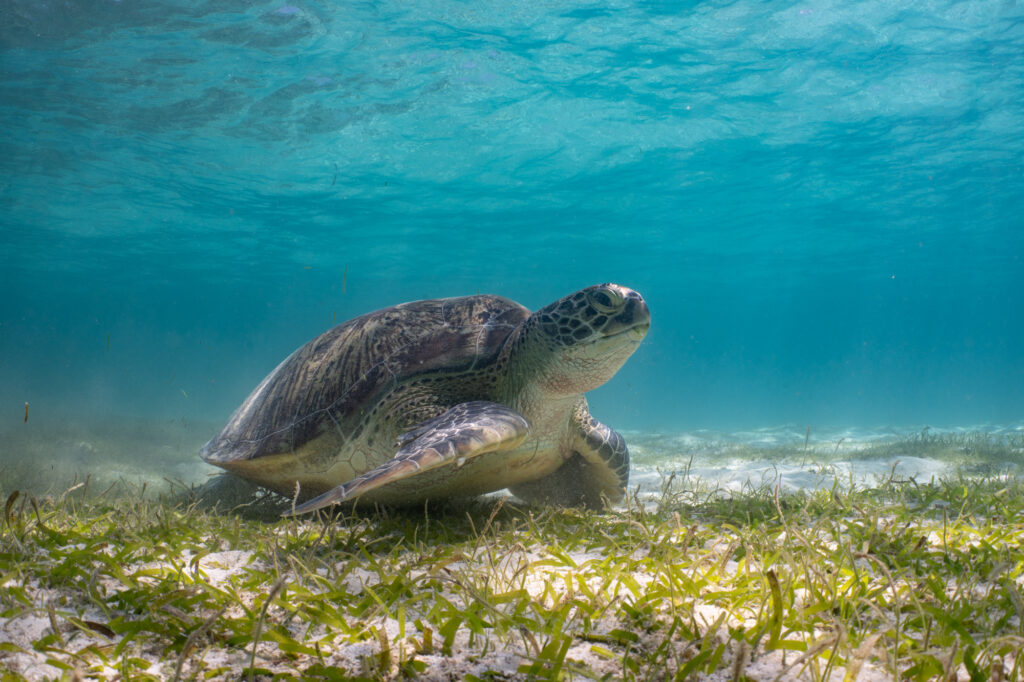
I saw my first turtle in the Maldives before the seaplane even landed. Bleary-eyed after 40 hours of non-stop travel, I was initially convinced that I was seeing things, but as I continued peering out across the reefs, the shape became unmistakable: a turtle surfacing to breathe, enormous even when viewed from far above. Seconds later, it fell away from view, replaced by vibrant reefscape, as the plane circled my new home for the next few months, the resort Six Senses Laamu. 

Above: A green sea turtle munches on the seagrass meadows that surround Six Senses Laamu.

I’m still pinching myself that I get to stay here, in one of the most biodiverse regions in the Maldives! As the second part of my OWUSS internship, I’m working for the Maldives Underwater Initiative (MUI), a cutting-edge marine biology center based at the resort. The team of scientists here spearheads research projects from seagrass surveys to manta monitoring, alongside guest and community education programs. MUI also partners with three non-profits – the Manta Trust, the Olive Ridley Project, and Maldives Resilient Reefs – establishing the center as a powerhouse of marine research in the region. As a new intern, my main role is to help document their science in action. 

My first week or so here passed by in a blur – settling in, meeting the team, hotel orientations, and of course absorbing as many marine biology facts about Laamu as humanly possible. But my first snorkel was absolutely unforgettable. I jumped in from one of the hotel jetties, intending for a quick dip just to explore. Almost immediately, I was face-to-face with one of the healthiest reefs I’d ever seen, blanketed by corals stretching off into the deep blue distance. Fish zipped past me in all directions, a riot of bright colors and beautiful patterns. Just when I thought the excitement had peaked, the megafauna arrived: a couple of green sea turtles perched atop a pinnacle, a blacktip shark on the hunt, and even an enormous Napoleon wrasse! Inevitably, my “short snorkel” evolved into an hour-or-two escapade, and I arrived back looking both very pruned and very happy at the thought of my upcoming time here. 

That snorkel made me realize just quite how far my baseline has shifted for healthy coral ecosystems. I’ve been lucky enough to dive on reefs all around the world, from the Caribbean to the Pacific, but the corals I’d previously encountered were always somewhat degraded, a patchwork of their former vitality. The only truly healthy corals I’d seen were in documentaries – the concept of a bustling reef seemed more a TV creation than a real-life possibility. But Laamu’s corals have transcended my baseline. Here, many nearby spots show near complete coral coverage, teaming with biodiversity across a vibrant, packed reefscape. This, among other factors, contributed to Laamu’s designation as a Mission Blue Hope Spot, a title given to special hotspots of marine biodiversity. Only 168 Hope Spots exist worldwide, emphasizing the pristine state of this atoll, sustaining marine life across the region.

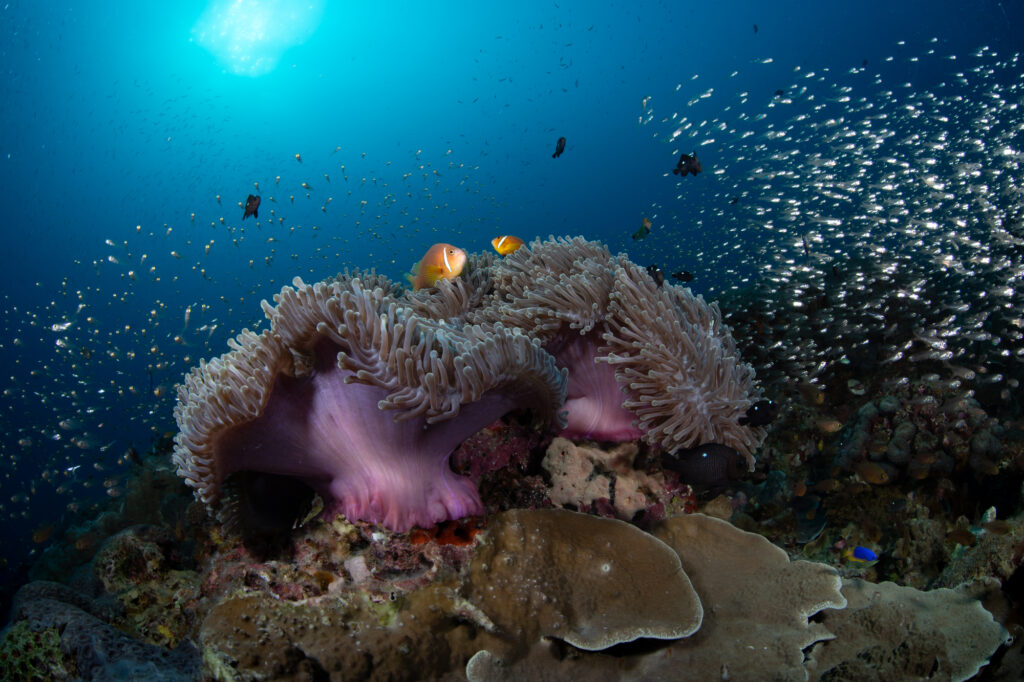
Laamu’s reefs, bustling with life and biodiversity

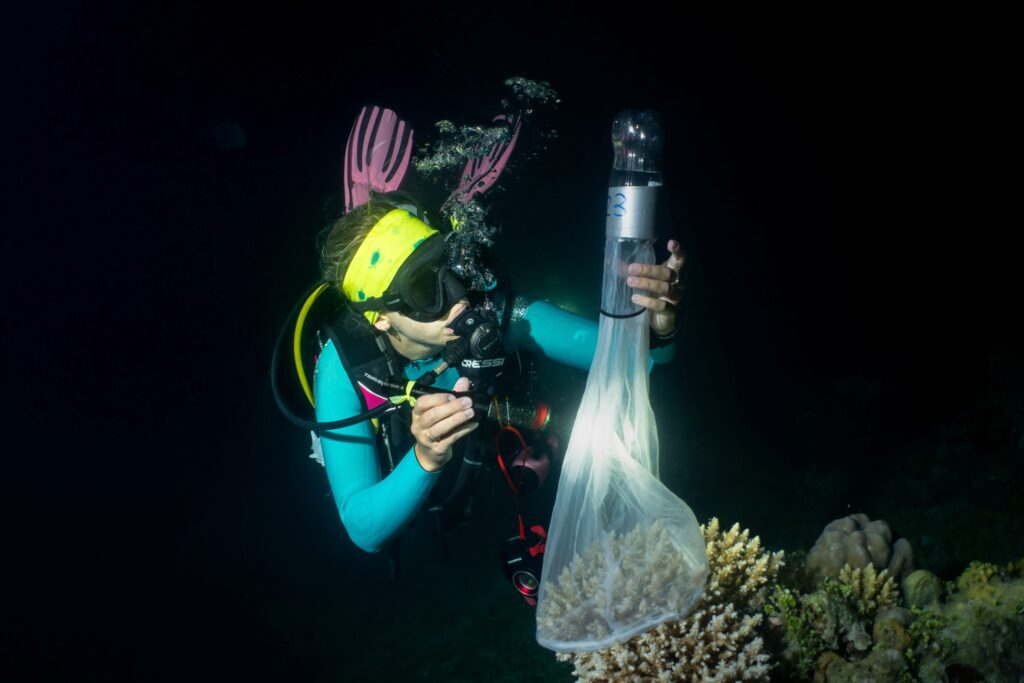
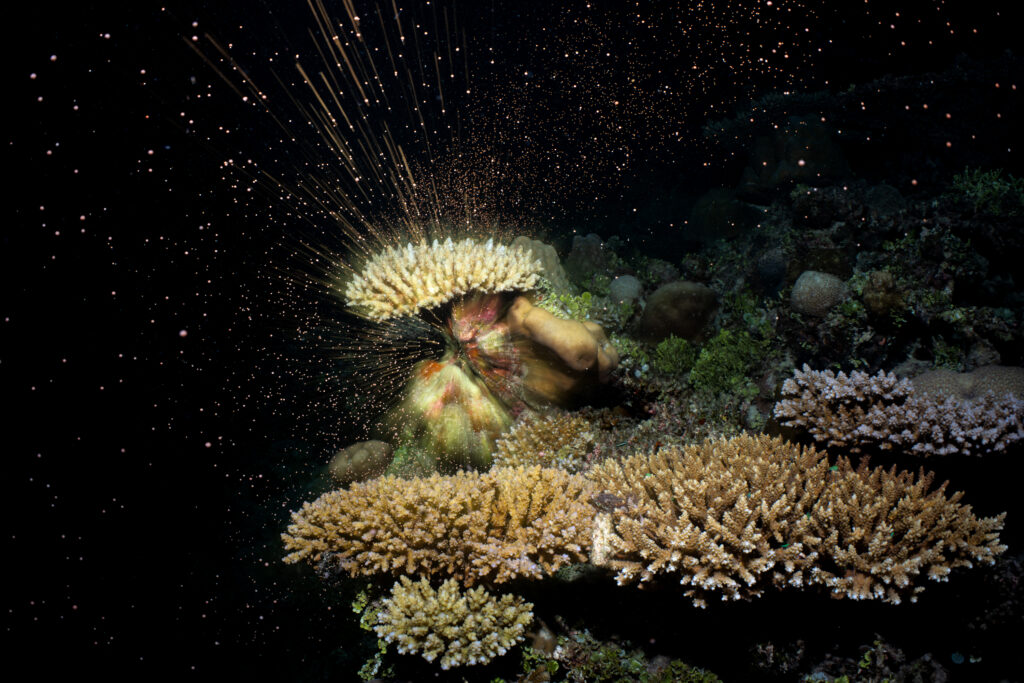
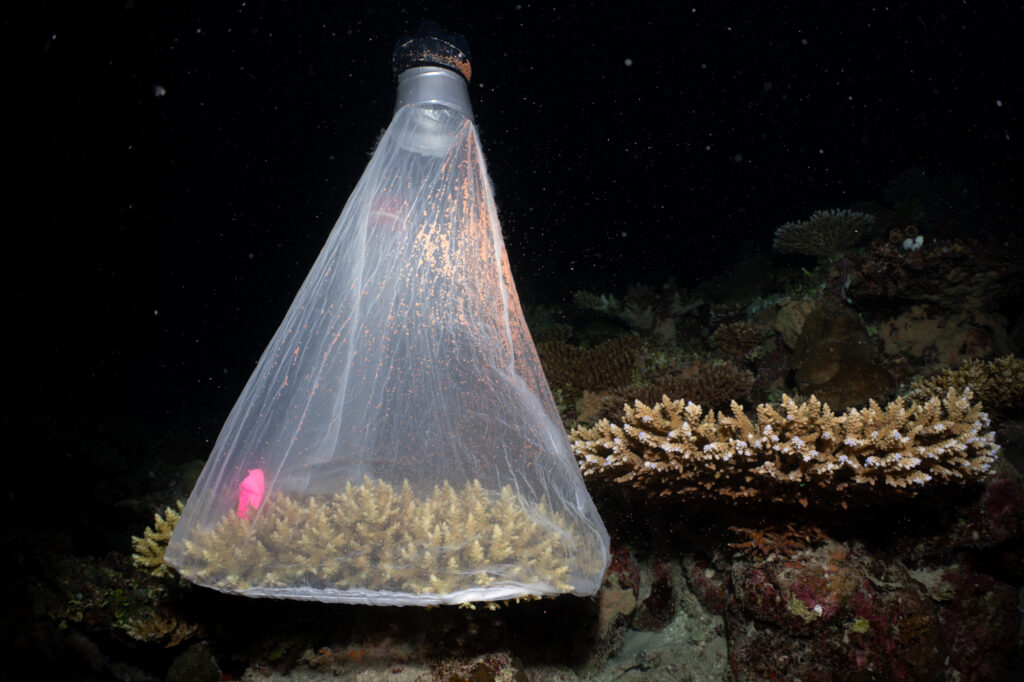
The local reef had one more welcome gift in store that week, by far the most mind-blowing experience of them all: coral spawning. Just after a handful of full moons each year, four different species of coral will release all of their eggs and sperm into the water, in a spectacular display of nature’s coordination. The event lasts only a few minutes, during which the black water transforms into a sea of brilliant pink dots, like snow flying away from the reef. The eggs and sperm mix into the water column, fertilizing them upon contact, sustaining the next generation of the reef. Here at MUI, we take that process one step further. During spawning, the team deploys around 20 cones over the spawning corals, designed to collect the eggs and sperm released. Our scientists then gather the catch of the cones and mix it at high densities, in turn can raise the fertilization rate by up to 80%. 

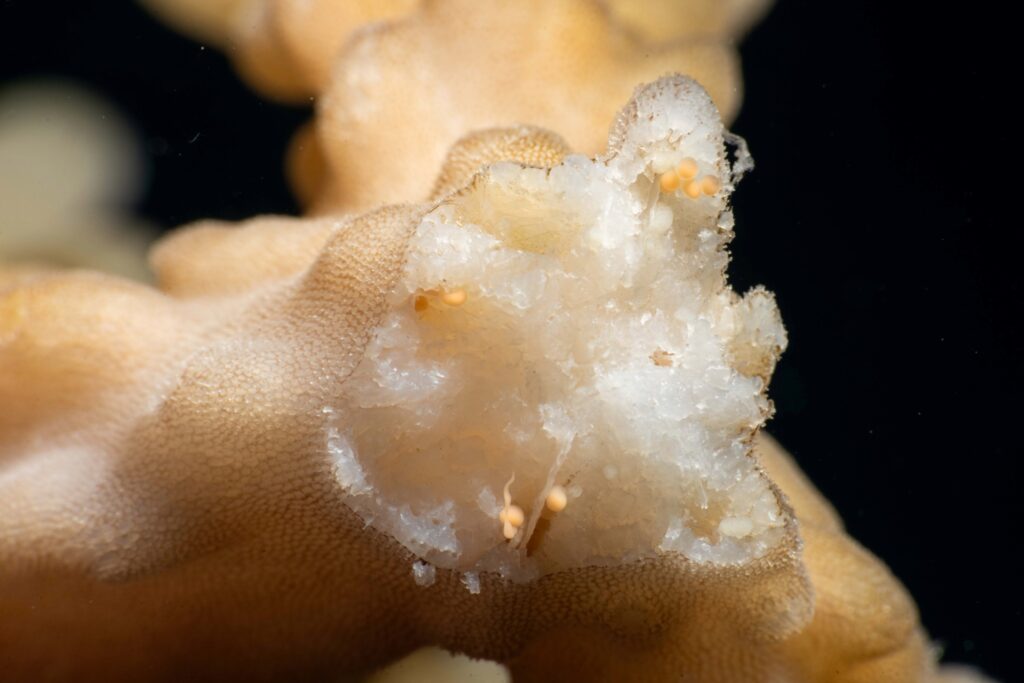
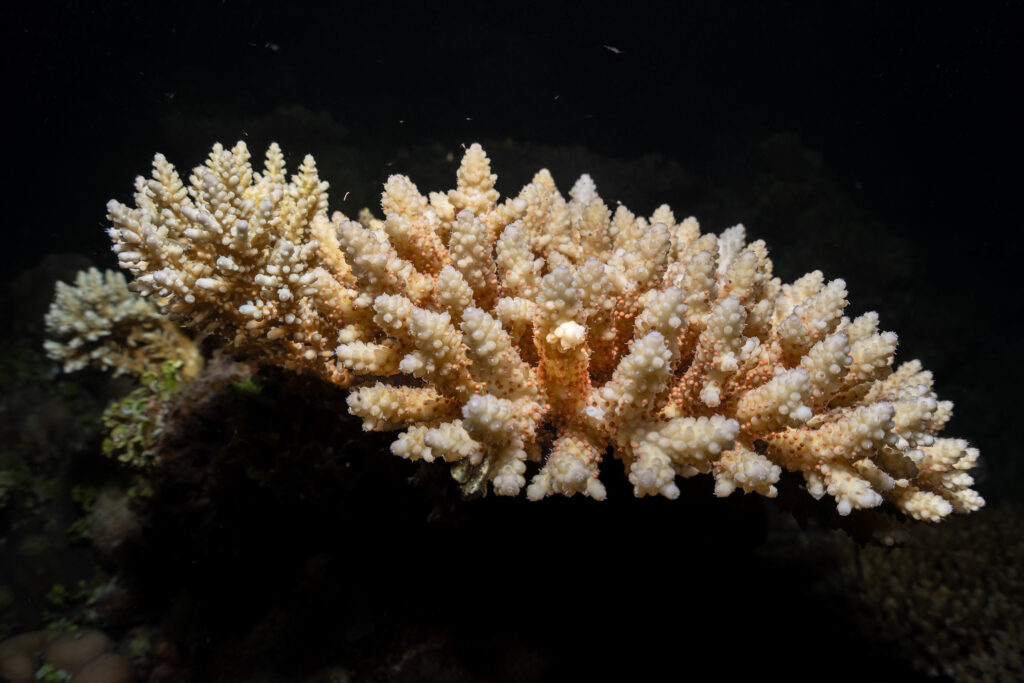
The week after I arrived, our team checked a few of the coral candidates and discovered that a few Acropora species were packed with tiny pink eggs inside – a sure sign of imminent spawning. Thus began our night dive routine – each night during the possible spawning timeframe, a few of our team would dive along the reef, checking for signs of activity. We mainly looked for the so-called ‘coral setting’ – when a coral moves its eggs to the outside of its polyps, priming them for release. Fearing I’d miss the action, I jumped on every scouting dive that I could – I wasn’t about to miss this once-in-a-lifetime phenomenon! 

Above: One of the Acropora corals our scientists sampled – the little pink dots are the coral eggs, a sure sign that spawning would happen within the next few days

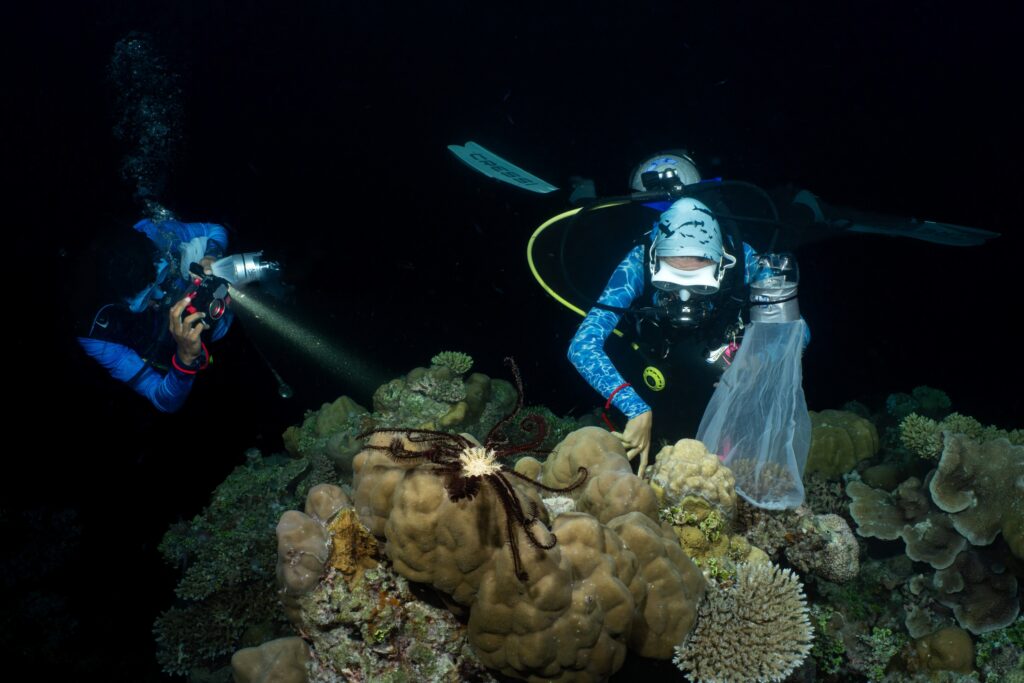
On night three, the news of coral setting finally came in! I was at a welcome dinner for new staff, dressed up for the special occasion, when I heard. Within 20 minutes, I’d raced to the dive center, traded my dress for my dive gear, and descended for the night dive of a lifetime. The MUI scientists were already in full swing, searching for setting and deploying coral cones up and down the reef. I found myself a beautiful little acropora dotted with tiny pink eggs, set up my camera, and began the wait. 

Above: An acropora dotted with tiny pink eggs, primed for release – this stage is known as coral setting
Below: MUI scientists deploy the egg-catching cones over corals with signs of setting. Once our dive team identified evidence of setting, we had about a 45 minute window to deploy as many cones as possible, to maximize our egg collection.

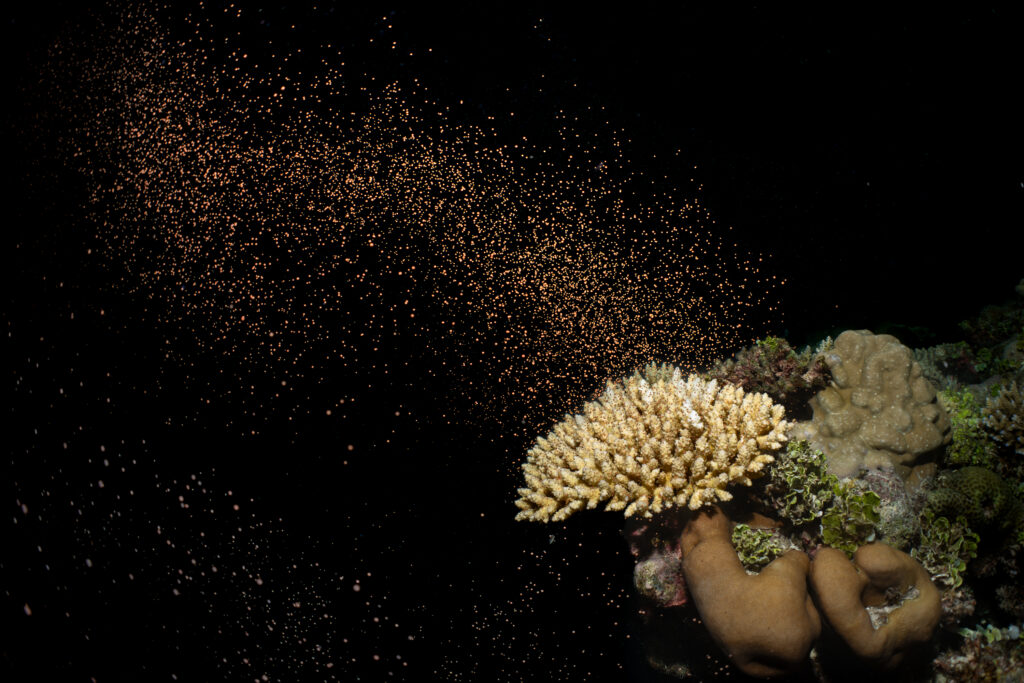
Around 9pm, I noticed the first little dots starting to dislodge, delicately floating up and away. Moments later, in perfect sync, the coral polyps released their eggs all at once, and hundreds rose into the water column like reverse snow. The sight was otherworldly, pink dots flying in all directions, the ultimate egg-splosion. I snapped away, trying to capture every second, and absorb the magic of the moment myself too! 

Above: A coral releases it’s eggs into the water column, slowly at first, then all at once: an egg-splosion of little pink dots. These photos were taken in the moments of peak spawning.

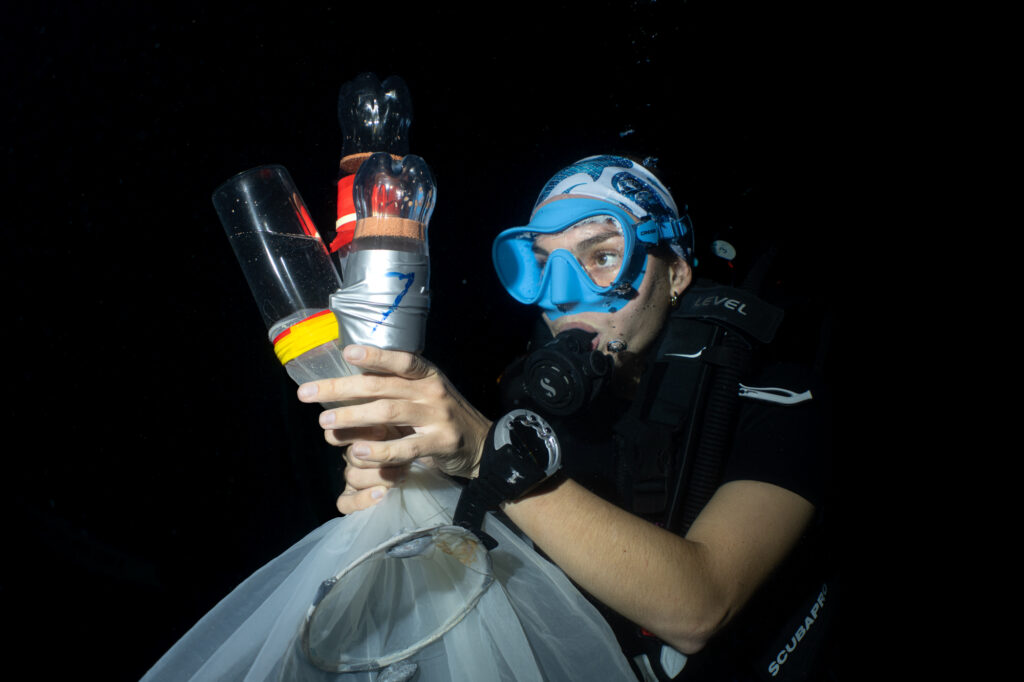
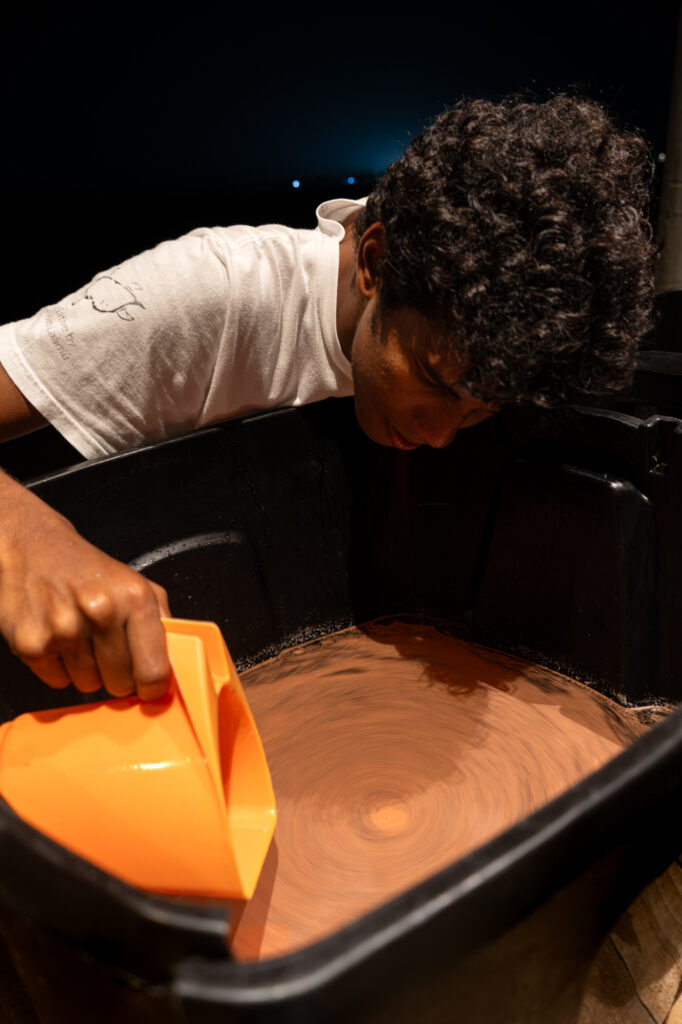
The show was over as quickly as it began – within five minutes, the eggs had drifted away, to begin the process of fertilization. But for our team, the work was only just beginning. Our dive team started by retrieving all 20 of the deployed cones, now filled with captured eggs. Upon sealing the cones shut, the surface support team dove down to bring the cones to the surface, appearing left and right like freediving phantoms. Back on land, our scientists then mixed all the cone contents together, a soupy concoction of eggs and sperm, fertilizing to become the next new corals on our house reef. 

Above: A deployed coral cone, post-spawning – the pink eggs are visible within the mesh netting.
Above: Talia, a MUI intern, collects three egg-filled coral cones to bring to the surface.

Above: Hadin, our coral researcher, stirs the eggs to improve fertilization. A close-up of the coral eggs in our fertilization bucket.

After an hour or so of incessant stirring, one of our scientists beckoned me over – she’d found the first signs of life! Peering through the macro camera, I saw a handful of so-called “coral butts,” the first cell division of each of the newborn corals. Success! 

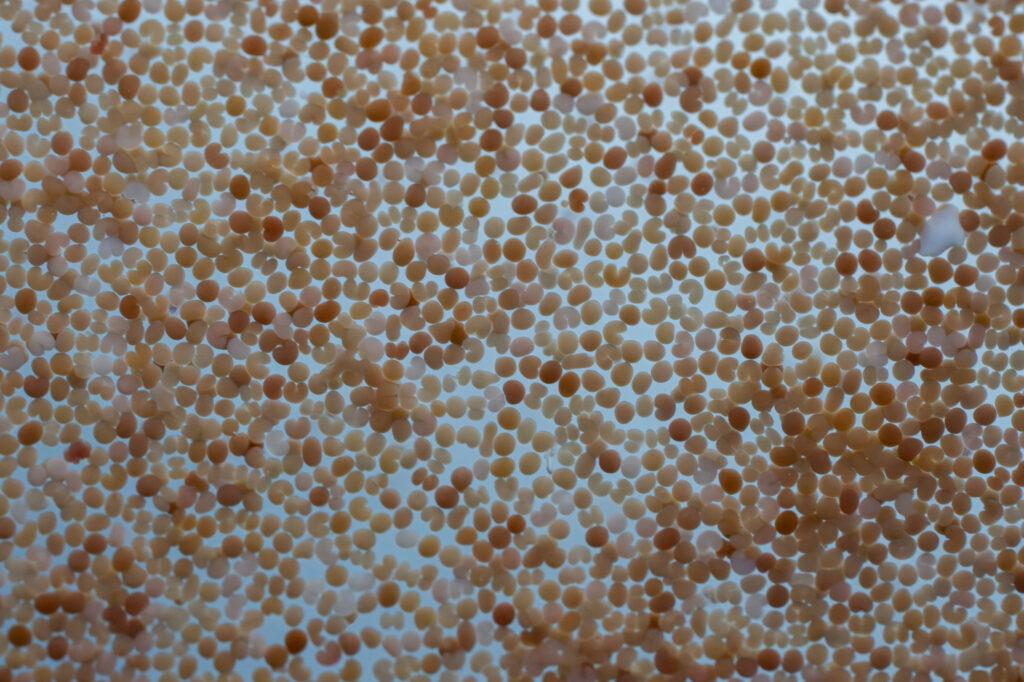
Above: A close-up of the coral eggs – looking closely, you can see lots of ‘coral butts,’ the first signs of fertilization

Within a week, the “coral butts” had morphed into coral larvae, microscopic little dots roving around our tanks, ready for new beginnings – our scientists released them right on our house reef, in hopes that they settle nearby and enrich our local ecosystem. Efforts like this are even more vital given the fine line between reef health and degradation. Just two years ago, Laamu’s reefs experienced a devastating mass bleaching event, affecting a significant amount of corals across the atoll. While many have bounced back remarkably, their resiliency to future heat stress remains to be seen.  Through our restoration, the MUI team hopes to keep our corals firmly on the side of healthy, bolstering our reef with influxes of baby corals and hopefully strengthening its chances against ocean warming. 

Share

Diving Into Summer: My First Month as a DAN Intern

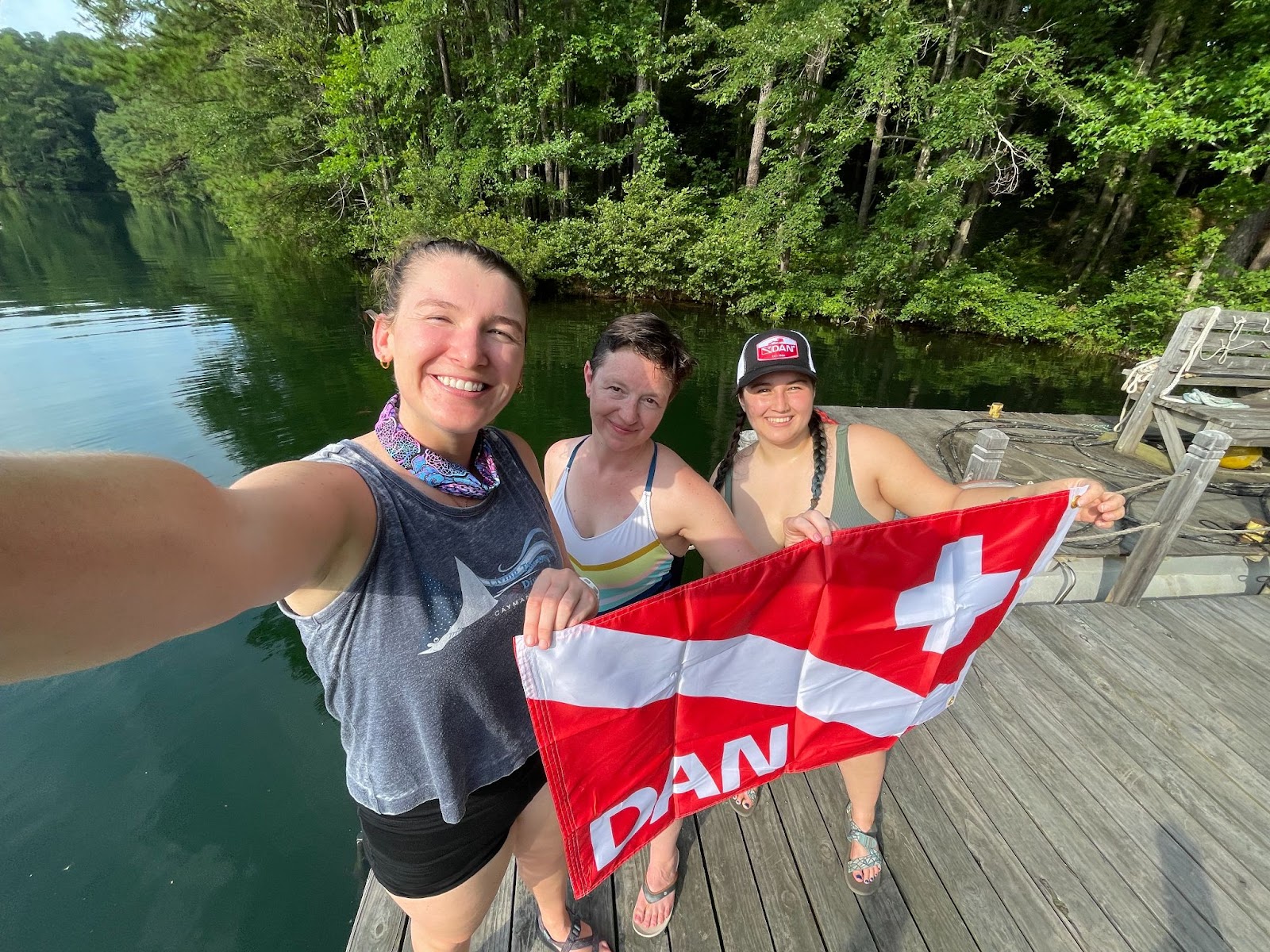
At Mystery Lake before a shakeout dive with another intern Tyler Horton (Left), VP of Research, Frauke Tillmans (Middle), and myself (Right).

My first month as a summer intern with Divers Alert Network (DAN) has flown by in a blur of training, new responsibilities, and creative challenges. From safety certifications to writing for public audiences, every week has offered a different way to grow.

Coming from a scientific and field-based background, switching into a marketing and communications role has been both fun and eye-opening. It’s been a welcome challenge to flex new muscles, learning how to package complex information, connect with a broad audience, and support DAN’s mission in a whole new way. 

We began with department introductions and initial assignments, and I quickly found myself involved in a range of ongoing projects. One early surprise was just how expansive DAN’s scope is. Like many divers, I was familiar with the membership and the accident insurance but often conflated the two. It was eye-opening to realize just how comprehensive the organization’s offerings are. Working on a professional liability press release gave me the chance to dive into the fine print of DAN’s insurance products and better understand the differences between coverage types, what’s included, and what’s not.

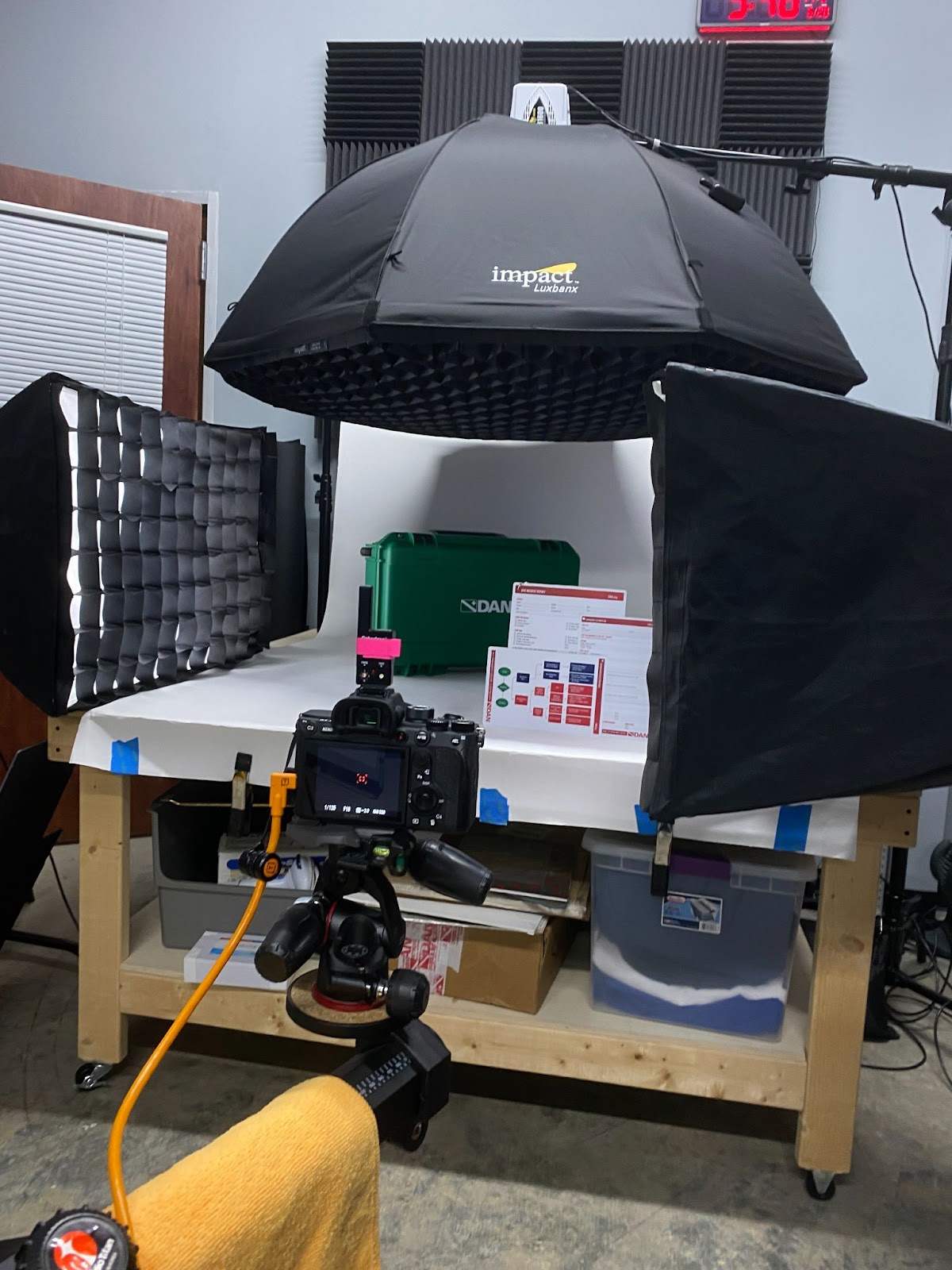
Alongside that, I’ve been helping shape outgoing communication by drafting newsletter language, contributing to blog posts, and developing content for social media. One of my favorite projects so far was drafting a blog post summarizing findings from a recent research paper on lung squeeze in freedivers. It was a rewarding opportunity to draw on my scientific background and translate the key takeaways into something more accessible for a general diving audience. I’ve also been assisting with marketing giveaways and product photography — specifically, capturing images of the oxygen safety slate. Coming from a wildlife photography and photojournalism background, this was a fun shift into studio photography. Learning how to set curves and shape light with strobes has helped me build new skills I’ve never had the chance to explore before.

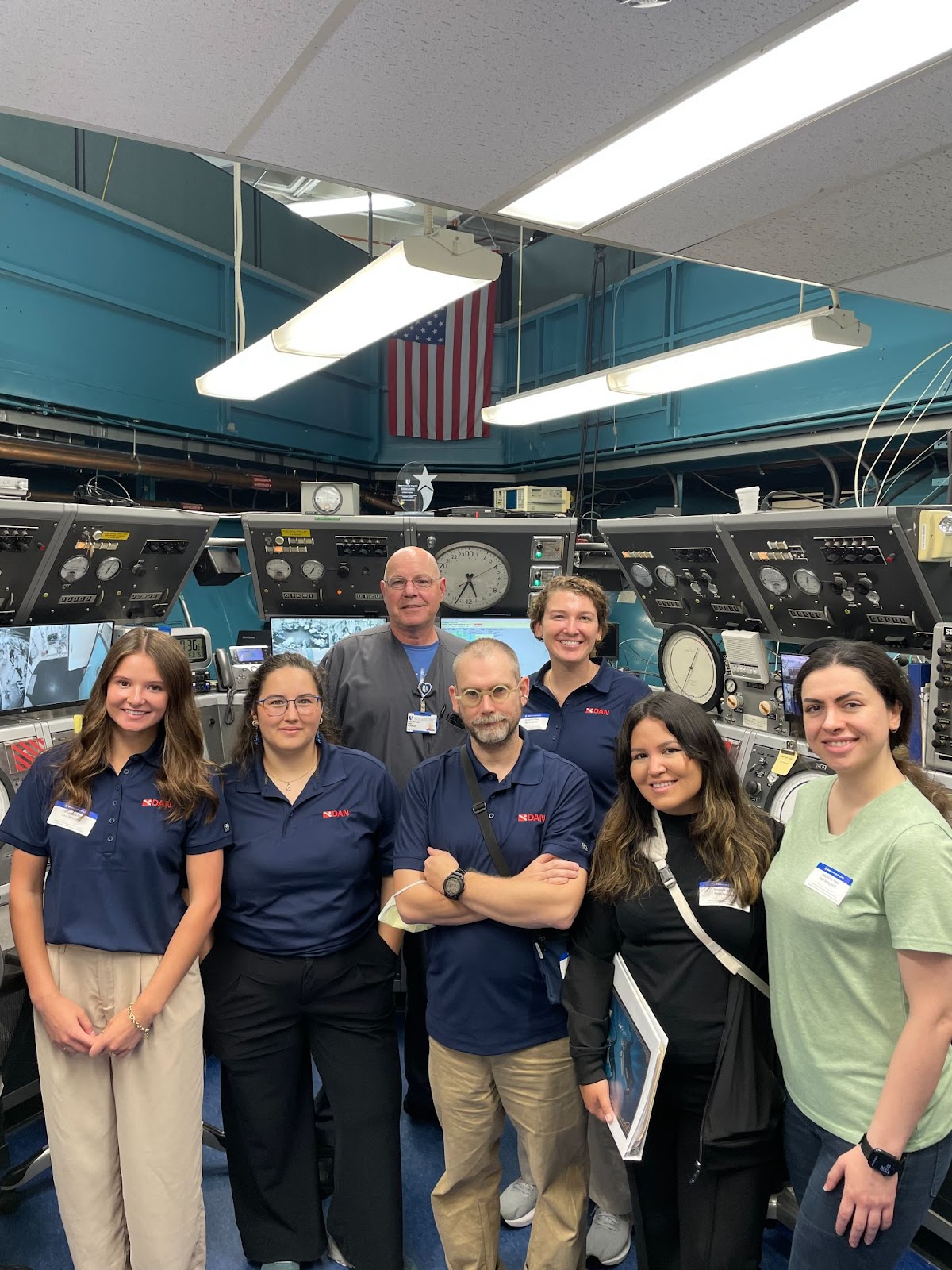
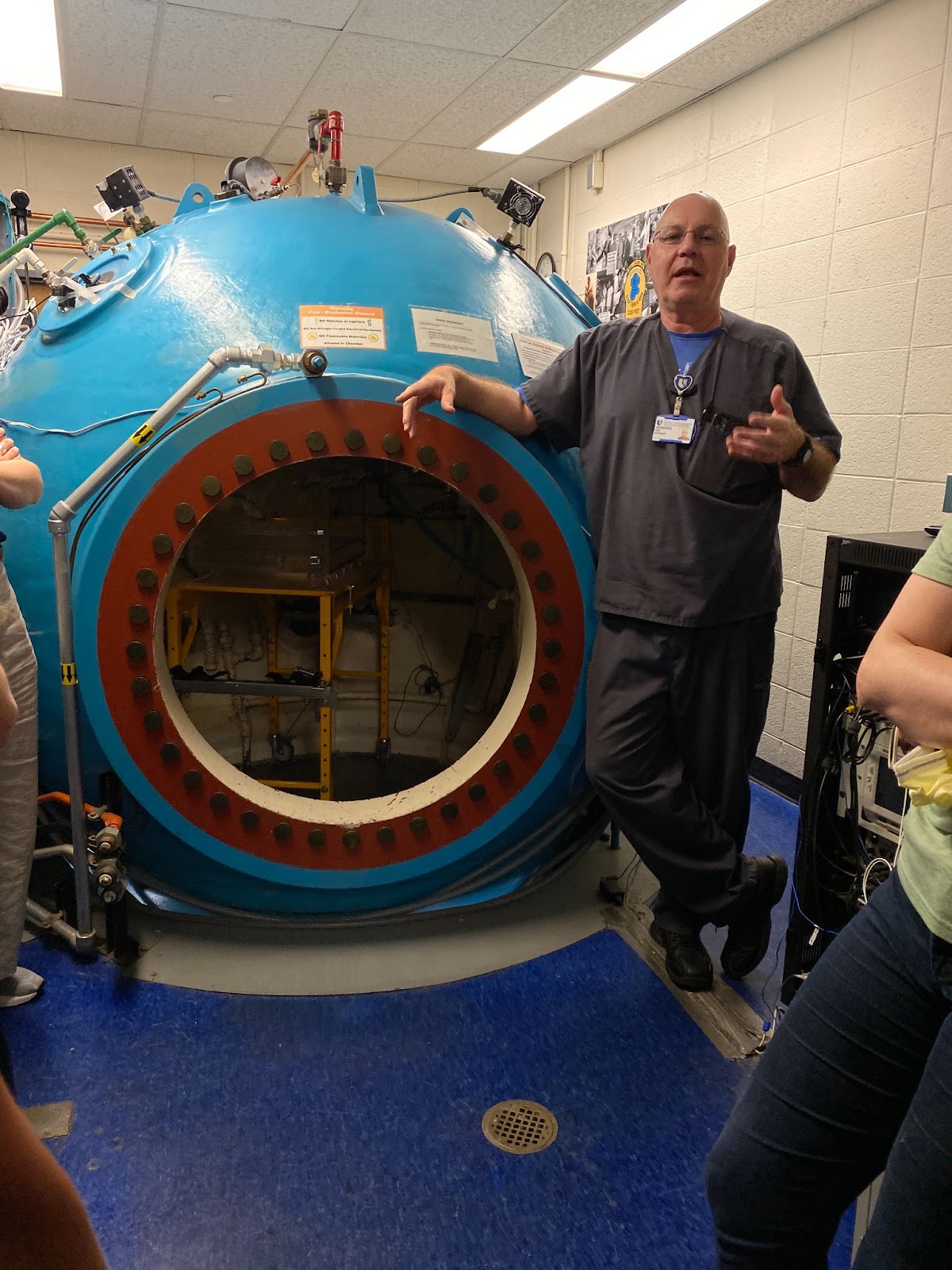
It hasn’t been all work, though. We’ve had the chance to do a few shakeout dives in local quarries and tour some key locations. Visiting Duke’s hyperbaric chamber facility helped me better understand how treatment chambers operate and are used for both dive-related and non-dive-related conditions. A visit to the Thunderbird cylinder factory gave us a look at how aluminum cylinders are actually manufactured.  

DAN Interns and some staff visiting the hyperbaric chamber at Duke University.
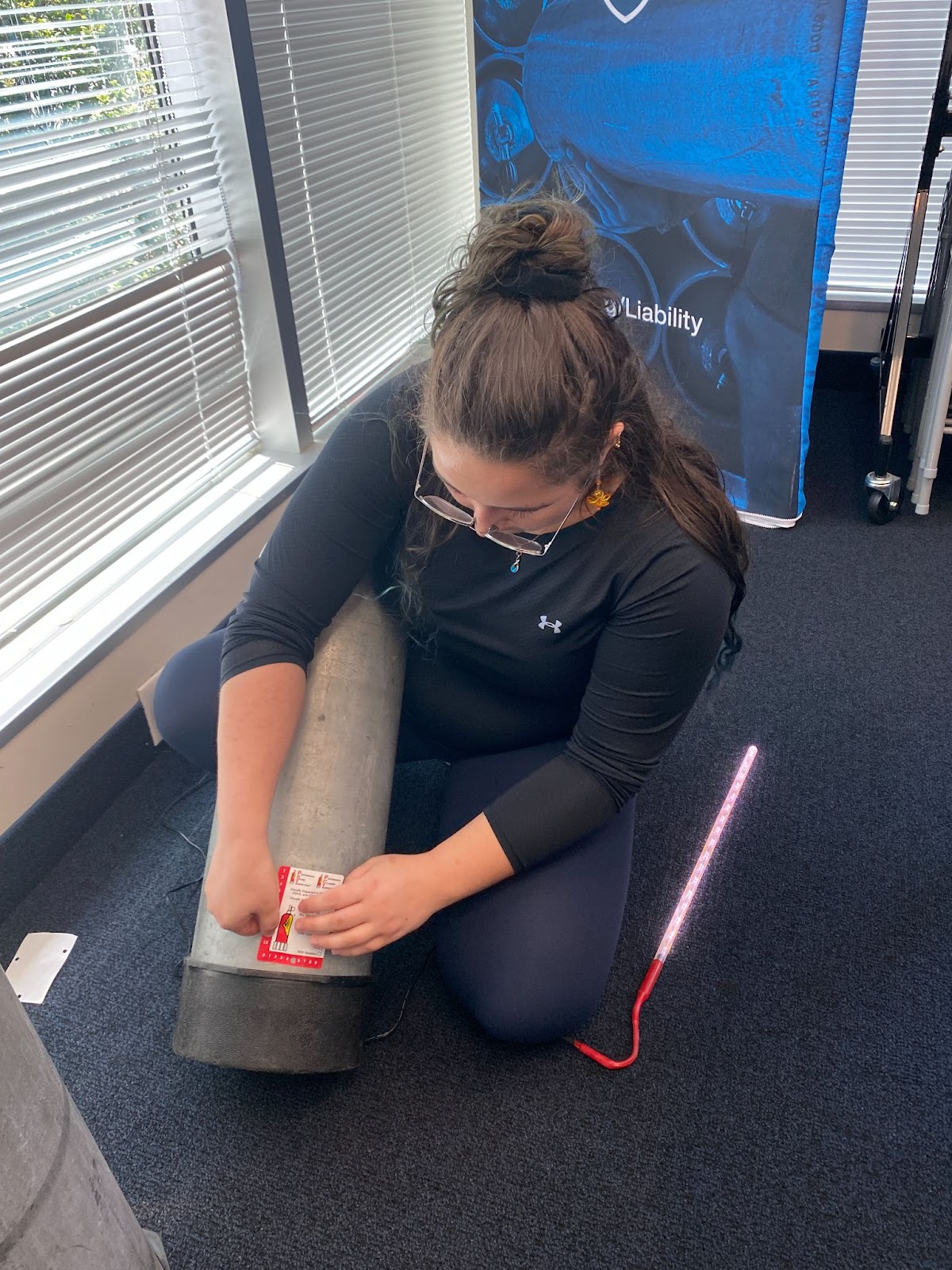
Anna Krylova/Myself applying a visual inspection sticker on a tank after the PSI/PCI course.
Duke Hyperbaric Technologist Eric Schinazi teaching about hyperbaric chamber Golf during a tour.

Training and professional development have also been a key part of this experience. I recently completed the Visual Cylinder Inspection course through PSI/PCI, which gave me a deep appreciation for the standards behind cylinder safety. I’ve begun the Intro to Technical Diving program and will be starting DAN’s First Aid for Diving Professionals (DFA Pro) certification soon. As the internship reaches its halfway point, I’m grateful for how much I’ve learned already.

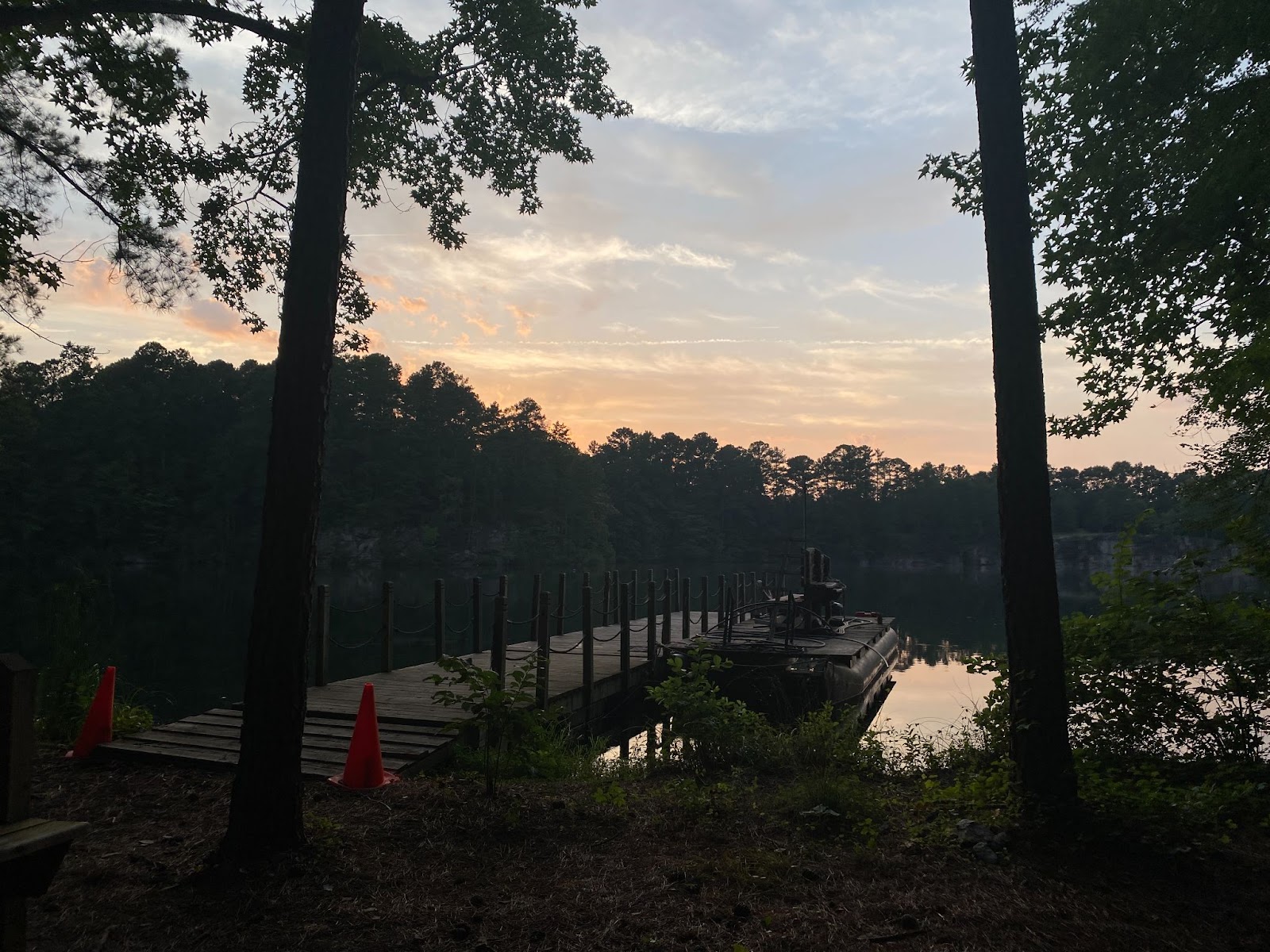
Sunset after shakeout dive at Mystery Quarry.
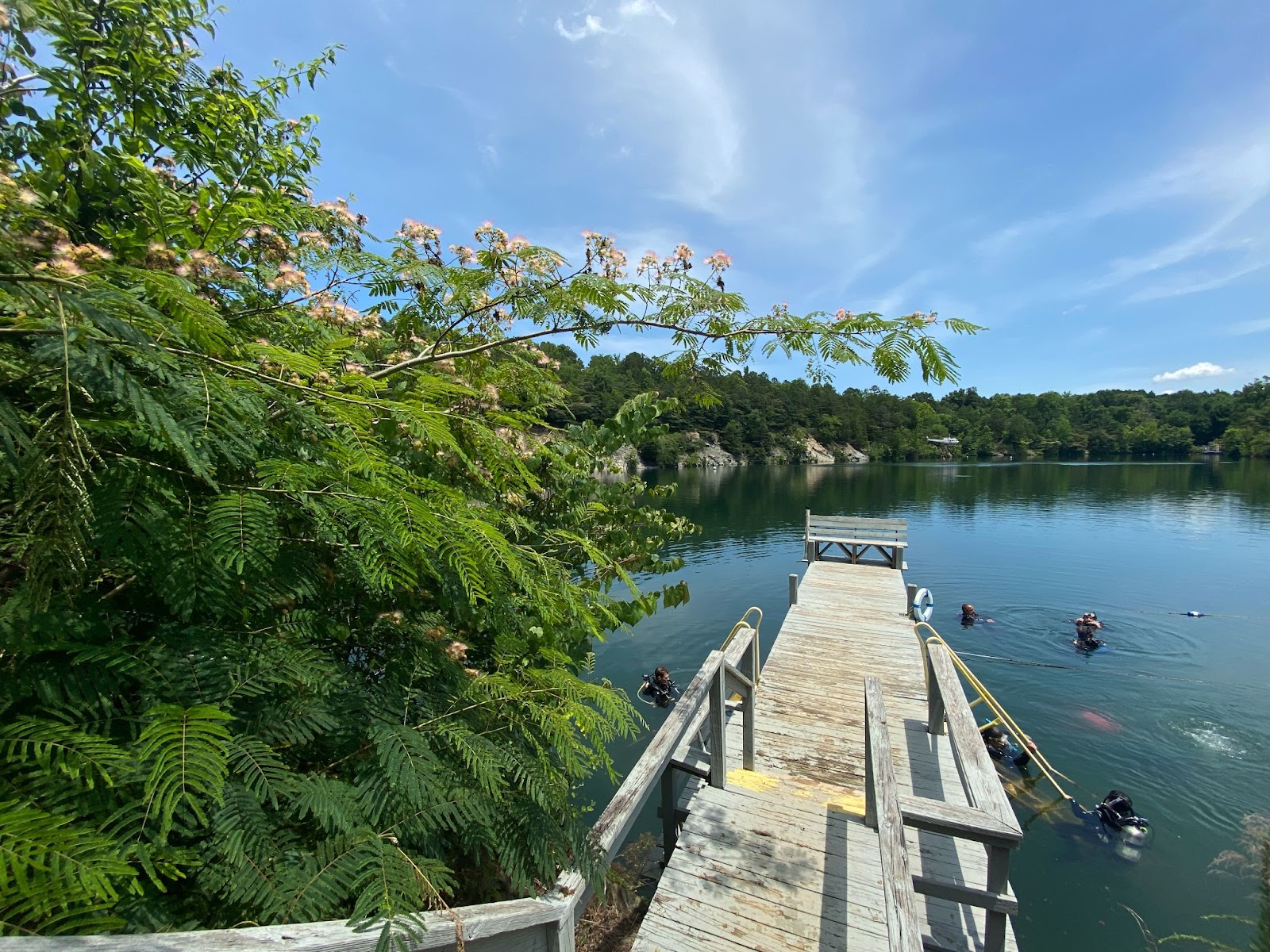
Another beautiful quarry picture at Bluestone during a surface interval.

Share