
Helping with the Shannon Point Marine Center scientific diving class taught me three main things: always discuss the dive plan in-depth before descending, never underestimate a student’s ability to lose their dive equipment, and that science is the best when you’re wearing neoprene. Whilst I have worked as a recreational divemaster, assisting with a science dive class was a totally different experience because it demands so much more of the students. I was paired with the newer divers to work on helping them feel comfortable doing their basic skills in the pool. It was a good experience to have to employ different methods of empathy, sincerity, and firm instruction in order to reach each person on their level and get them to do their skills with a smile on their face. Each day came with its own challenges but the supportive atmosphere of the class remained the same each day. My favourite thing to observe was when there was a student who was confused about how to do the BCD remove and replace skill underwater and another student who had just mastered it remained on that skill with him and kept giving tips and tricks until he could not only do it but felt confident doing it.
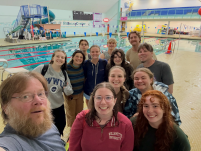
Credit: Derek Smith
Caption: the dive class team after a particularly challenging pool session with big smiles on our faces
The first open-water dive was at a lake, and as a simple introduction to science diving we did a trash cleanup. We found some very exciting objects such as a wallet with a $100 bill in it which just so happened to belong to a friend of one of the students in the class… you never know what may wash up. This day I learned the power of team work when it comes to the success of a dive. Some students were quite nervous about the dive and the ones who worked together to discuss their concerns ended up having a great time and ones who didn’t vocalise their concerns didn’t have as positive of an experience. After this, I began to go around each student individually at some point before the dive to make sure they didn’t have any concerns/questions. Not only did this help them feel more comfortable and make the dive objective easier to achieve but it also allowed for me to have a more personal interaction with them. As such, assisting with the class helped me develop my dive leadership skills.
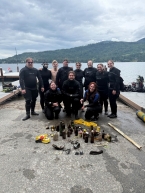
Credit: Lifeguard at Lake Whatcome
Caption: the dive class after their first successful open water dive featuring our trash haul
A big part of my role in the dive class was to assist the DSOs with their prep and cleanup pre and post dives. I had no idea that there was so much behind the scenes work which had to be done to make a dive class run smoothly. We had to plan the dive locations based on the current and tide tables, as well as planning all of the equipment and tasks for the divers to complete, all of which needed to be done efficiently and safely. Through working in the dive locker I learned a lot about equipment handling. I assisted with tank visual inspections and performed simple gear maintenance tasks which taught me how to fix many common gear related issues and developed my general troubleshooting skills. After the class the DSOs and I spent many hours running tanks to and from the local dive shop to be filled which provided an insight into the true life of a DSO and allowed me some time to ask questions of them. In this time I learned how hard it is to manage a dive class and the stresses which come with such responsibility, in addition to the joy and enthralling stories which being in the ocean every day provides.
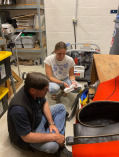
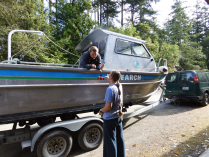
Credit: Caden Delano
Caption: left – me assisting DSO Nathan Schwarck with preparation in the dive locker, right – me assisting a student with post-dive boat breakdown
Whilst helping with the dive class was an overall joyful experience, it did come with some unique challenges. There was a day where we were doing a deep dive followed by a night dive and when we arrived at the deep dive location there was significant swell which meant we couldn’t put the bow door down of our front loading vessel and it made everyone feel seasick. Luckily, my sea legs were on that day and by some stroke of magic I was the only one who didn’t get seasick. As such, I found myself untangling weight belts, lifting gear setups onto people’s backs, coaching people through deep breaths, and putting on 12 sets of fins to prevent people from having to bend over while at their worst. That was challenging enough not to mention that 5 students had never done a back roll entry before, so in this swell I counted down “3… 2… 1” and with a slight push here and there, they all did it. The visibility on that dive was so bad that I was incredibly grateful for my dive light since once we hit 80ft it was essentially a night dive. Following that, the actual night dive was hilarious. It was what can only be described as “The Shrimpening”, the photo says more than I can with words but it was like swimming through pure shrimp. There were also a number of dives where I felt the true power of the ocean in the form of strong currents. Coming from Florida, I had never really experienced anything as intense as these tidal changeovers. As such, being a leader in this class helped me to gain a lot of experience in varying dive conditions and to learn the extent of my limits as a diver.
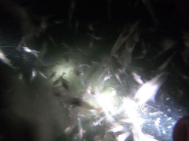
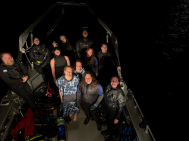
Credit: left – Lily Moore, right – Nathan Schwarck
Caption: left – it’s raining shrimp!, right – the dive class post night dive feeling accomplished
Overall, helping with the dive class helped me become a more confident diver in harsher conditions and allowed me to develop my skills as a dive leader. But most importantly, to learn how to lift other divers up and make some lifelong friends.
